Bradford Engineer Honoured for Role in Moon Landing
December 3, 2025From Bradford to NASA: Michael Dinn’s Contribution to Space Exploration
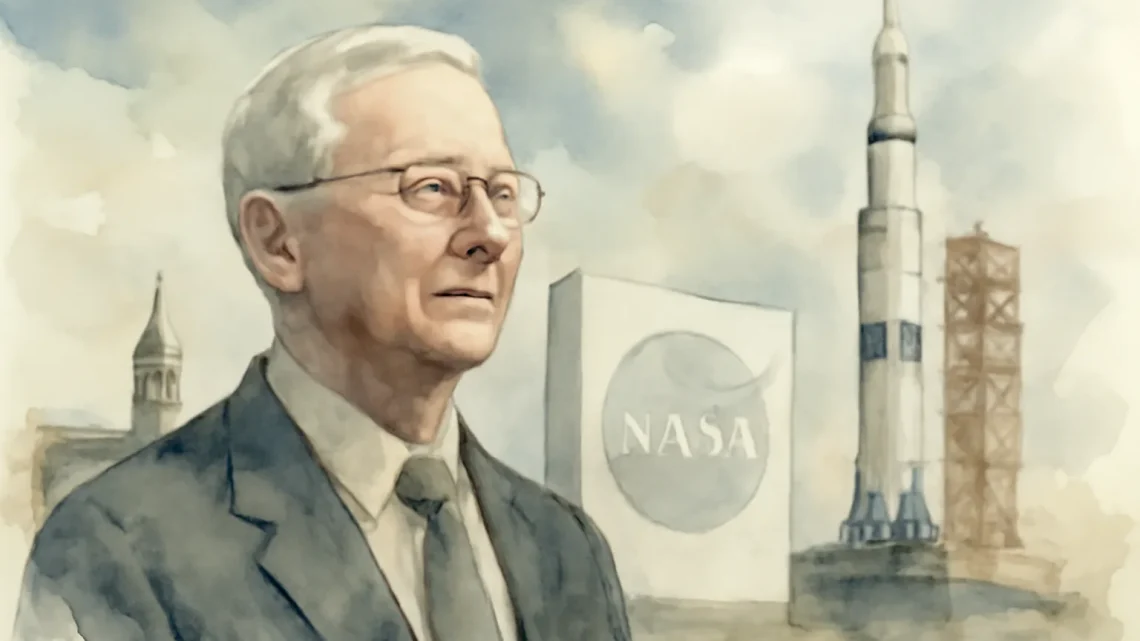
Michael John Dinn, a Bradford-born engineer, has been recognised for his significant role in NASA’s Apollo Moon landing missions. The University of Bradford awarded him an Honorary Doctorate of Engineering in December 2025, acknowledging his contributions to deep space tracking and exploration. Born in Bradford in 1933, Mr Dinn’s engineering career spans key developments in space communications and technology.
Early Life and Education
Michael Dinn grew up in Bradford, attending local schools including St Bede’s and St Joseph’s primary school. His early education was interrupted during the Second World War when he was evacuated to Silsden. He later studied electronics at Bradford Technical College, which later became the University of Bradford, graduating in 1955.
Before moving abroad, Mr Dinn worked in the UK engineering sector, including a position at English Electric in Thornbury. In 1960, he emigrated to Australia, initially expecting a three-year contract.
Career in Space Tracking and NASA
In Australia, Mr Dinn joined the Royal Australian Air Force’s Aircraft Research and Development Unit. By 1966, he was Deputy Director of Operations at NASA’s Deep Space tracking station in Canberra. The following year, he moved to the Honeysuckle Creek tracking station, which played a crucial role in the Apollo missions.
- Honeysuckle Creek transmitted the first live television images of Neil Armstrong’s Moon landing in 1969.
- Mr Dinn and his team maintained communications during the Apollo 13 mission’s critical return.
- He contributed to the design of NASA’s 64-metre antenna at Tidbinbilla.
- He led support for Voyager missions to Uranus and Neptune.
- As Director of the Canberra Deep Space Communication Complex, he oversaw missions including Galileo and Magellan.
Mr Dinn retired in 1994 after a distinguished career in space communications.
Legacy and Connection to Bradford
Now in his 90s and residing in Australia, Michael Dinn remains connected to Bradford through family and social media. He expressed surprise and gratitude for the honorary degree, reflecting on his early days in the city and the role his education played in his career.
The University of Bradford continues to advance space research and technology through initiatives such as the Bradford-Renduchintala Centre for Space AI. The centre focuses on satellite technology, artificial intelligence, data science, and sustainable space systems, building on the legacy of pioneers like Mr Dinn.
For more information on the University of Bradford’s space research, visit www.bradford.ac.uk.