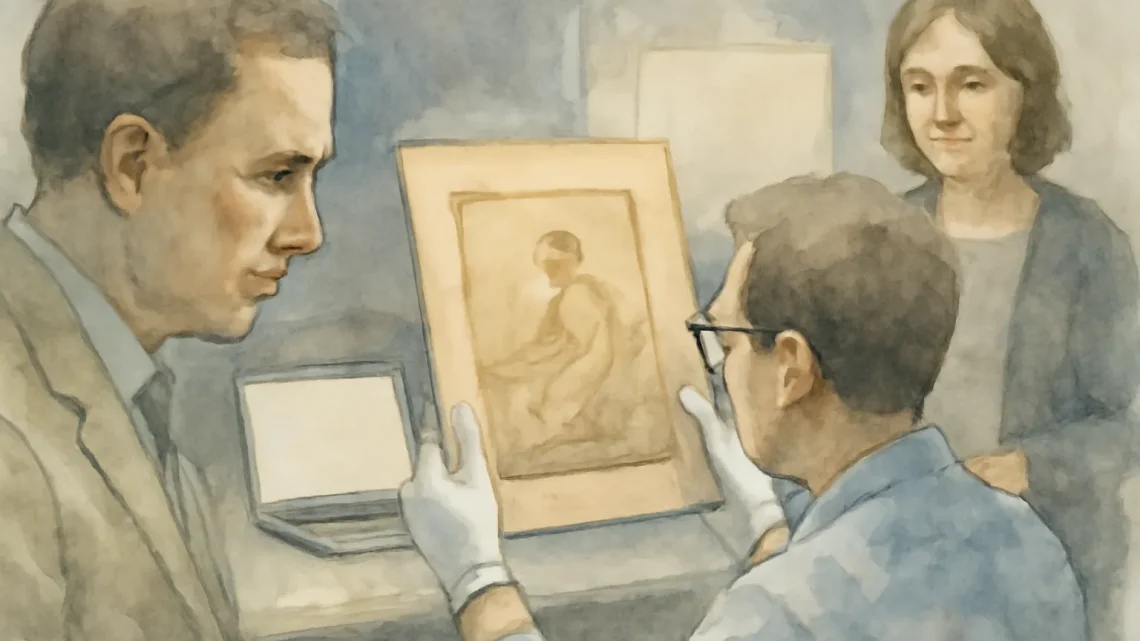
AI System Detects Forged Drawings with High Accuracy
June 17, 2026New technology analyses key visual features to support art authentication
Researchers at the University of Bradford have developed an artificial intelligence (AI) system capable of distinguishing genuine drawings from forgeries with nearly 90 per cent accuracy. The AI assesses just five key visual features to identify an artist’s unique style, providing a data-driven tool to aid experts in authenticating artworks.
Study details and methodology
The research, published in the journal PLOS ONE, involved testing the AI on 900 authenticated drawings by ten artists spanning five centuries. These artists include notable figures such as Michelangelo, Raphael, Whistler, and Constable. The dataset was compiled from images sourced from several major institutions, including the Metropolitan Museum of Art, the Morgan Library, the Ashmolean Museum, the Royal Collection Trust, the Victoria and Albert Museum, and Casa Buonarroti.
The AI system examines visual elements such as line structure, texture, contrast, tonal variation, and structural complexity to build a “visual fingerprint” unique to each artist. This fingerprint allows the system to compare new drawings against known authentic works and flag those that do not match the established style.
Performance and implications
- The AI achieved an overall accuracy of 89.8% in distinguishing genuine works from forgeries.
- It correctly accepted genuine drawings 83% of the time.
- The system rejected fake drawings with over 90% accuracy, minimising false positives.
This high level of accuracy is particularly significant in reducing false acceptance of forgeries, which can have serious consequences in the art market, legal disputes, and insurance claims. The ability to work effectively with limited data—learning from as few as 20 authenticated drawings per artist—makes the system practical for real-world applications where large datasets are often unavailable.
Context and future developments
Traditionally, authenticating drawings has relied heavily on expert judgement, which can be subjective and limited by the availability of verified works. The Bradford team’s AI offers a complementary approach by providing a reproducible and evidence-based assessment. However, the researchers emphasise that the technology is intended to support, not replace, human expertise.
The study also highlights how specialised AI models tailored to specific tasks can outperform larger, more general AI systems, especially when data is scarce. The researchers suggest that future developments could incorporate additional visual features and integrate other types of evidence, such as material analysis and provenance records, to further improve authentication accuracy.
Broader significance
Beyond the art world, accurate authentication has wide-ranging implications, affecting museums, collectors, insurers, and the global art market. By combining computational analysis with expert knowledge, this technology aims to enhance transparency and reliability in the authentication process.
For more information, the full research paper is available in PLOS ONE.