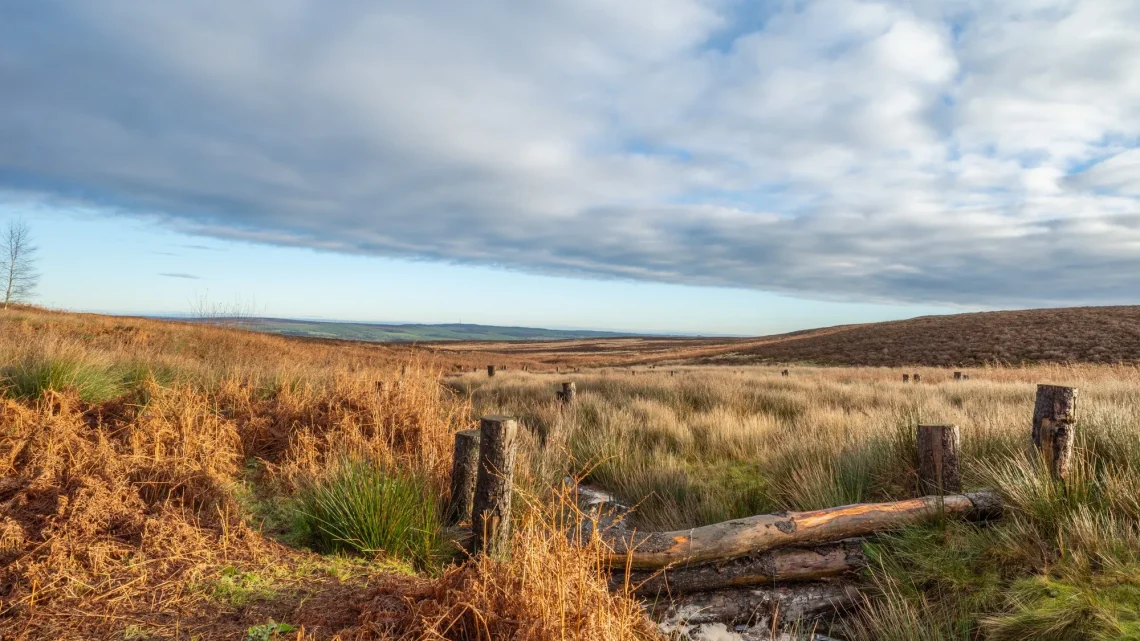
One Year on Ilkley Moor: A Moorland Restoration Story
June 1, 2026Since 2024, a steady programme of restoration work has been carried out on Ilkley Moor to repair degraded peatland and improve the landscape’s resilience to flooding and wildfire.
Editors Note: The following article, images and video footage was kindly submitted by Adam Kingston, a British-German photographer and researcher based in Leeds (UK) and Wrocław (PL).
This work, undertaken by the Moors for the Future Partnership, Bradford Council, Rebel Restoration and the Friends of Ilkley Moor, is part of a broader regional effort to restore West Yorkshire’s upland habitats. By installing stone, timber, coir, and heather dams, the project aims to “slow the flow” of water, encouraging the re-wetting of the peat. These physical interventions, alongside the planting of sphagnum moss plugs and the clearance of invasive Sitka spruce, are essential for natural flood management and increasing habitat diversity.
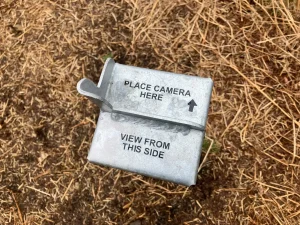
To monitor these changes, four fixed-point photography posts were installed at various restoration sites. These posts feature QR codes, inviting the public to contribute to a visual record of the moor’s recovery. While the primary goal of the posts is data collection, they also offer a specific framework for looking at the landscape – one that challenges the usual habits of the photographer.
Observation through Repetition
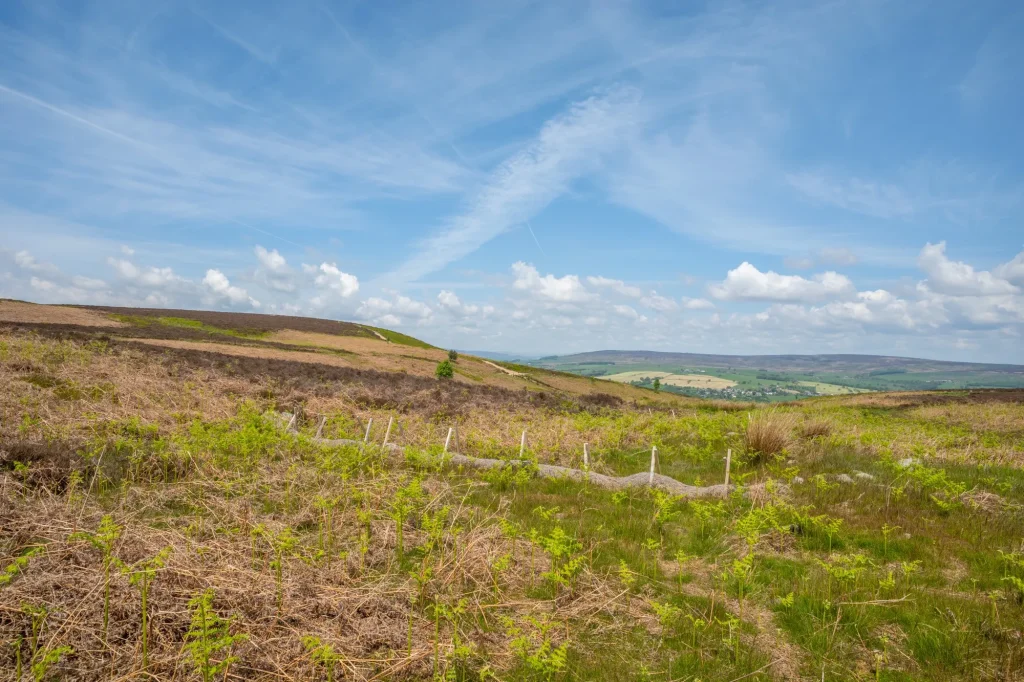
I first encountered these posts while making photographic work for a university project. At first, I saw them purely as tools for documentation, but I soon became interested in the specific kind of photography they encouraged. In most landscape work, the photographer spends time moving through the space and adjusting the composition to suit a particular mood or aesthetic. A fixed-point post removes these variables entirely, as the viewpoint is predetermined and the subject already chosen.
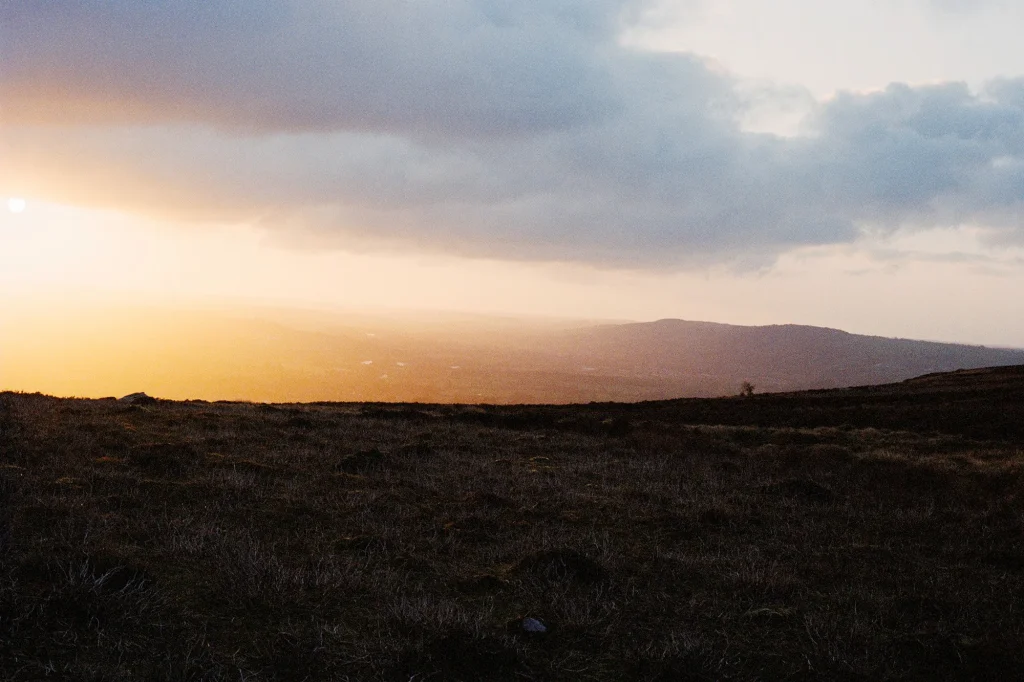
With these creative decisions settled in advance, the emphasis shifts away from the act of “making” a picture and towards a reiterative process of observation and comparison. This approach feels appropriate to the restoration work itself, which is gradual rather than dramatic. The effects of re-wetting or vegetation management are rarely obvious from one visit to the next. However, fixed-point photography allows small changes to become visible through repetition: the way water gathers or recedes in a newly blocked gully, the softening of the ground after cutting, the subtle chromatic shifts as different grasses and heathers take their turn to dominate, and the way the moor responds to the cycle of rain, frost, and sun.
Resisting the Interpretive Image
While public participation is central to the monitoring scheme, I felt I could contribute something more technically consistent. My motivation was partly a reaction to the way we photograph the outdoors today. Most people using the posts will likely rely on smartphones, which are increasingly designed to produce “interpretive” images rather than faithful records. By default, phone software tends to intensify skies, lift shadows and sharpen details to create an over-saturated, punchy file.
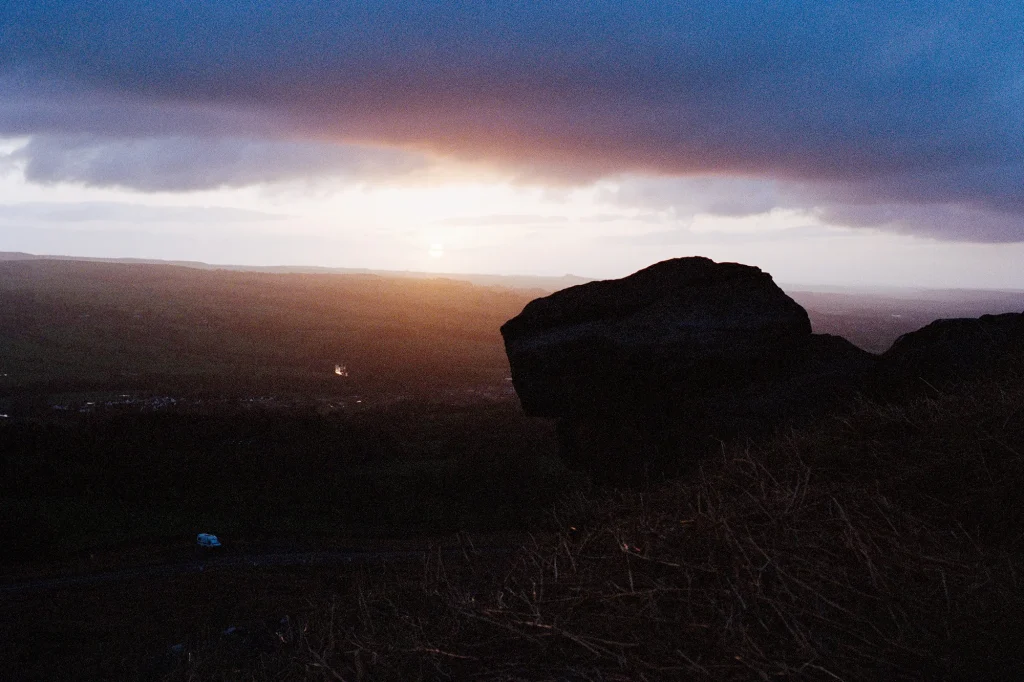
On Ilkley Moor, where the atmosphere is frequently muted, damp, or tonally subtle, this automatic processing can fundamentally alter the character of the landscape. I wanted my images to feel restrained and descriptive, preserving the actual conditions in which they were made. To achieve this, I used a dedicated camera and strictly avoided HDR or AI-driven post-processing. I wanted the final sequence to be a clean, factual record, allowing the subtle shifts in the landscape to speak for themselves.
A Year in Sequence
I set myself the task of returning to the four posts once a month for a full year. This required a certain level of persistence, working around the unpredictable weather and my own travels abroad, while ensuring I photographed from each point as consistently as possible. The routine was simple, but it changed the way I looked at the moor. Each month, I’d return to the same positions, check the frame, make the pictures, and leave.
During some visits, the landscape appeared almost static. In the middle of a dry spell or a deep winter freeze, it felt as though very little had changed. However, when the images were eventually placed together, these small shifts began to register with surprising clarity. The films that emerged from this process are quiet rather than spectacular. Instead of presenting the restoration as a dramatic “before-and-after” event, they show it as a gradual unfolding of time.
The Sensory Environment
The routine I needed to sustain to complete the project also gave me a much greater appreciation for the wildlife that this open habitat sustains. Over the course of the year, the moor revealed itself to be far more populated than it first appeared. Across my visits, I encountered common lizards, an adder, field voles, curlews, lapwings, and a barn owl hunting at dusk. While there were perhaps too many red grouse and pheasants, their presence is inseparable from the moorland experience.
If the resulting films lack one thing, it’s the soundtrack of the moor. Not only the wind, but also the song of skylarks overhead, which was a constant feature of my visits.
Practical Limitations and Final Work
Despite the suggestion of precision that a fixed-point post provides, the landscape often resists complete control. The posts themselves were subject to the elements, shifting slightly in the ground as the peat expanded and contracted with the seasons. The low winter sun also presented practical difficulties at two of the points; at one, long shadows fell directly into the frame, while at another, the camera was aimed almost directly into the light. I had to learn to balance the desire for absolute consistency with the practical need to make images that were clear enough to be useful for documentation.
I now plan to exhibit the films alongside grids of prints made from their constituent frames, together with related work from the moor. My hope is that the presentation will hold together the environmental significance of the restoration work and the photographic discipline of returning to the same viewpoint over an extended period.
Each of the films, along with further context on the restoration programme, can be found on my website.